
Creative destruction
A major challenge facing civil society organisations is how to pursue the ideal that brought them into being while achieving efficiency and maintaining control over their own processes. Anyone who has made a decision about their workplace has had to consider its…
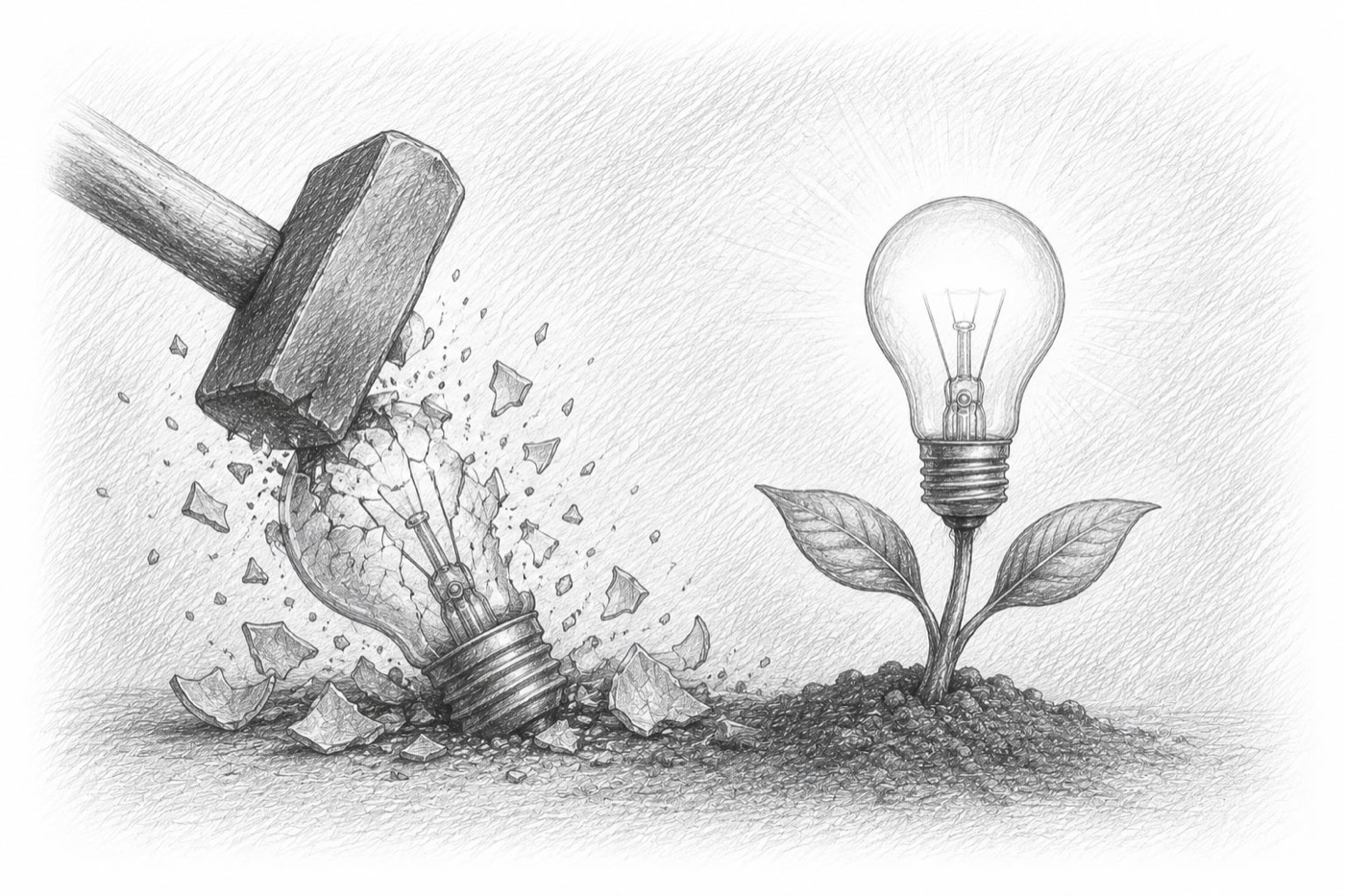
A major challenge facing civil society organisations is how to pursue the ideal that brought them into being while achieving efficiency and maintaining control over their own processes.
Anyone who has made a decision about their workplace has had to consider its contribution to society and what makes it an attractive setting for professional development. At times, employees may also have felt constrained or prevented from developing as they would have wished, or found hierarchy such a tangible barrier that it obstructed fellowship or the expression of their best abilities. Luigino Bruni addresses these and many other dilemmas in La destrucción creadora (Editorial Ciudad Nueva, 2019). He adds a distinction rarely examined with such honesty and insight, focusing on ideal-driven organisations and on communities and initiatives born of a charism.
Dr Cristina Calvo, who wrote the foreword, offers a definition of charism that, to my mind, forms the central argument of the book. A charism is “a gift for seeing, with the eyes of the spirit, things that others do not see”. It is the ideal, the passion for carrying a dream forward, for pursuing what one considers excellent. Because it also involves the spirit, it engages the whole person. It is not confined to religion but can also arise in civic life.
“And so, when charisms are absent or silenced in communities and organisations, life together loses beauty, sensitivity and spiritual strength, and we begin to settle for small, dispiriting goals.”
Paradoxical as it may sound, remaining faithful to their charism and maximising the impact of their values on society require ideal-driven organisations to renew their organisational forms continually. They must also remain receptive to the world and avoid the self-referential outlook that turns a charism into an ideology. At the same time, they must make room for the development of the people within the organisation. How, then, can a founder or director reconcile the success of the charism with the organisation’s institutional development? This requires an appreciation of the paradox of gratuitousness: “For people to flourish, and thereby enrich themselves, the organisation and the world, we must not possess them, consume them or use them, even for the noblest purposes.”
Bruni turns to the notion of munus—the freely given gift we receive that obliges us to reciprocate—to distinguish community from immunity. Because the latter negates the former, ideal-driven organisations must place their trust in their members, allowing creativity, innovation and virtues such as loyalty to express their commitment. They must understand what “arises from differences between people, from the meeting of their diverse talents and from dialogue between their motivations”. The book’s title, Creative Destruction, revolves around this idea, referring to Austrian economist Joseph A. Schumpeter’s account of the transformation that accompanies innovation. Bruni brings these concepts into the realm of ideals, organisations and charisms. He shows that success often requires letting old conceptions die, founders delegating works that have fulfilled their purpose, and welcoming the talents of new people who discover their vocation within the charism—allowing them to recognise themselves and “follow the best part of themselves”.