
How will you measure your life?
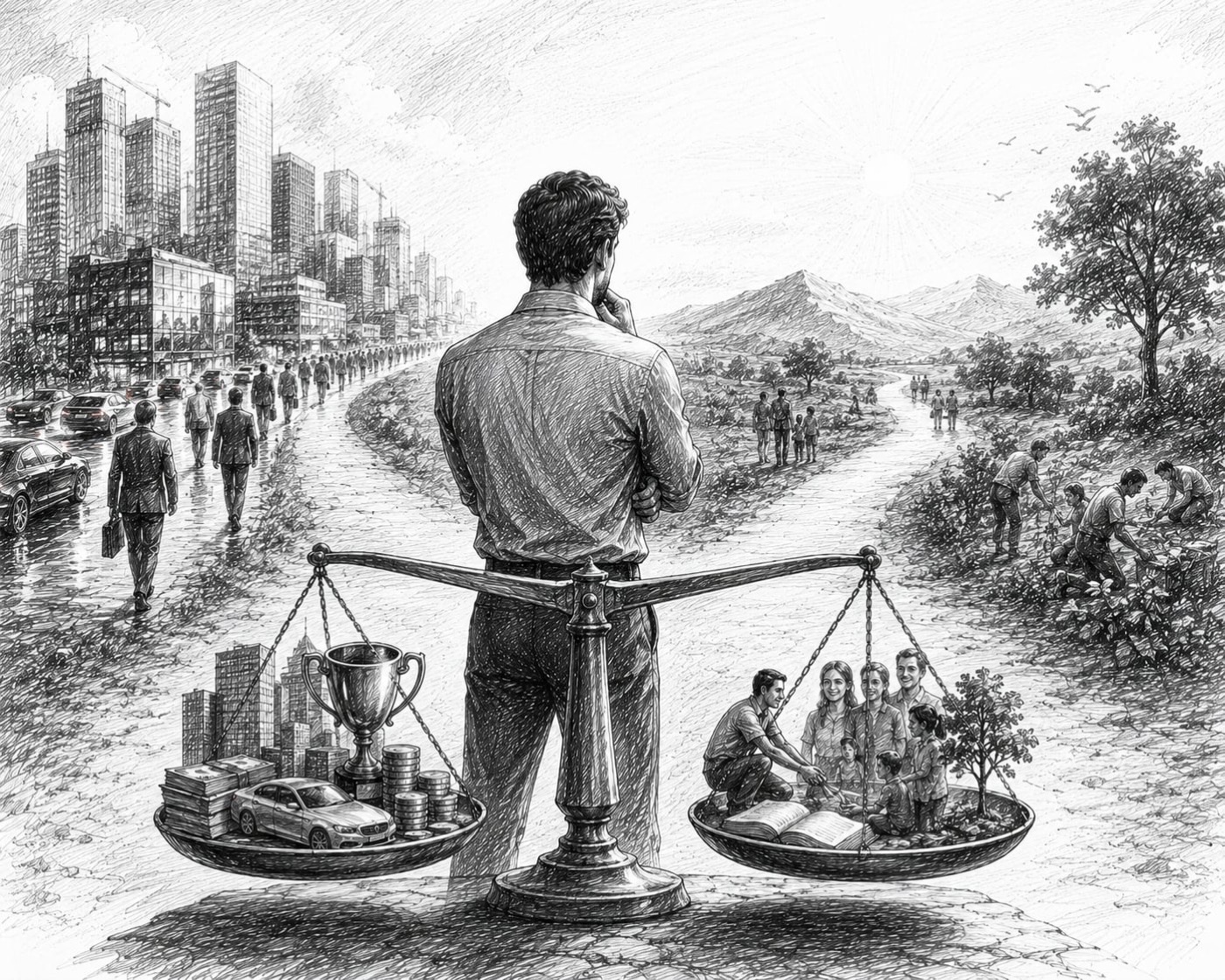
We would like to reproduce in full an article published by Clayton M. Christensen in Harvard Business Review in 2010. It explores the central argument of his book How Will You Measure Your Life?, which we believe can offer considerable value to mission-driven nonprofit organisations.
Article by Clayton M. Christensen, originally published in Harvard Business Review.
Before publishing The Innovator’s Dilemma, I received a call from Andrew Grove, then chairman of Intel. He had read one of my early articles about disruptive technology and asked whether I could speak to his direct reports, explain my research and discuss its implications for Intel. Excited, I flew to Silicon Valley and arrived at the appointed time, only for Grove to say: “Look, things have happened. We only have ten minutes for you. Tell us what your disruption model means for Intel.” I said I could not: I needed a full thirty minutes to explain the model, because only with that context would any comments about Intel make sense. Ten minutes into my explanation, Grove interrupted: “Look, I have your model. Just tell us what it means for Intel.”
I insisted that I needed another ten minutes to explain how disruption had unfolded in a very different industry—steel—so that he and his team could understand how it worked. I described how Nucor and other mini-mills had begun by attacking the bottom of the market, reinforcing steel bars, before moving upwards and undermining traditional steelmakers.
When I finished the mini-mill story, Grove said: “All right, I understand. What it means for Intel is…” He then articulated what would become the company’s strategy to enter the bottom of the market with the Celeron processor.
I have thought about that a million times since. If I had been drawn into telling Andy Grove what he should think about the microprocessor business, I would have been in trouble. Instead of telling him what to think, I taught him how to think; he then reached what I believed was the right decision himself.
That experience profoundly influenced me. When people ask what I think they should do, I rarely answer directly. Instead, I pose the question aloud through one of my models. I describe how the process in the model unfolded in an industry quite different from theirs. Usually, they say: “All right, I understand.” They then answer their own question more insightfully than I could.
My class at Harvard Business School is designed to help students understand what constitutes a good management theory and how one is built. Around that framework, I arrange models and theories that help students think through the different dimensions of a general manager’s work in stimulating innovation and growth. In each session, we examine a company through these theories, explaining how it reached its current situation and considering what management actions would produce the required results.
On the last day, I ask students to turn those theoretical lenses on themselves and find convincing answers to three questions. First, how can I be sure I will be happy in my career? Second, how can I be sure that my relationships with my spouse and family become a lasting source of happiness? Third, how can I be sure I will stay out of prison? Although the last question sounds light-hearted, it is not. Two of the thirty-two people in my Rhodes Scholar class spent time in prison. Jeff Skilling of Enron fame was a classmate at HBS. These were good people, but something in their lives sent them in the wrong direction.
Making deals does not produce the profound rewards that come from strengthening people.
As students discuss these questions, I open up my own life as a case study, illustrating how they can use our theories to guide their life decisions.
One theory that illuminates the first question—how to find happiness in our careers—comes from Frederick Herzberg. He argues that the powerful motivator in our lives is not money, but the opportunity to learn, grow in responsibility, contribute to others and be recognised for our achievements. I tell students about a vision I had while running the company I founded before becoming an academic. I imagined one of my managers leaving for work one morning with relatively high self-esteem. Then I pictured her returning to her family ten hours later, feeling unappreciated, frustrated, underused and demeaned. I imagined how deeply that would affect her interactions with her children. My mind then moved to another day, when she returned home with greater self-esteem, feeling she had learned a great deal, been recognised for valuable achievements and played an important role in successful initiatives. I imagined how positively this would affect her as a wife and mother. My conclusion was that management, practised well, is the noblest profession. No other occupation offers so many ways to help others learn and grow, assume responsibility, gain recognition and contribute to a team’s success. Increasingly, MBA students arrive believing that a business career means buying, selling and investing in companies. That is unfortunate. I want students to leave my classroom understanding this.
Create a strategy for your life
A theory useful for the second question—how to make family relationships a lasting source of happiness—concerns how strategy is defined and implemented. Its central insight is that a company’s strategy is determined by the initiatives in which management invests. Unless resource allocation is managed skilfully, the resulting strategy can differ greatly from what management intended. Because companies’ decision-making systems tend to direct investment towards initiatives with tangible, immediate returns, they underinvest in work crucial to their long-term strategies.
Over the years, I have watched the lives of my HBS classmates from 1979 unfold. Increasingly, they have arrived at reunions unhappy, divorced and estranged from their children. None graduated with a deliberate strategy of divorce and raising children who would become distant. Yet a startling number implemented precisely that strategy. They failed to keep their life’s purpose at the centre of decisions about how to spend their time, talents and energy.
It is striking how many of the nine hundred outstanding students HBS attracts each year have given little thought to their life’s purpose. I tell them that HBS may be one of their last opportunities to reflect deeply on it. If they think they will have more time and energy later, they are mistaken. Life becomes more demanding: a mortgage, seventy-hour working weeks, a spouse and children.
Having a clear purpose has been fundamental in my own life, but I had to think long and hard before understanding it. As a Rhodes Scholar, I followed a demanding academic programme while trying to fit an additional year of study into my time at Oxford. I decided to spend an hour every evening reading, thinking and praying about why God had put me on this earth. It was a difficult commitment: every hour spent on it was an hour not studying applied econometrics. I struggled with whether I could afford the time away from my studies, but persisted and eventually discovered my purpose.
Had I spent that hour each day learning the latest techniques for resolving autocorrelation in regression analysis, I would have misspent my life. I use econometric tools a few times a year, but my understanding of my life’s purpose every day. It is the most useful thing I have learned. I promise students that if they take the time to discover their purpose, they will remember it as their most important discovery at HBS. Without it, they will drift rudderless through life’s rough seas. Clarity of purpose matters more than activity-based costing, balanced scorecards, core competencies, disruptive innovation, the four Ps and the five forces.
My purpose arose from my religious faith, but faith is not the only source of direction. One former student decided that his purpose was to bring honesty and economic prosperity to his country and raise children equally committed to that cause and to one another. His purpose centres on family and others, as does mine.
Choosing and successfully pursuing a profession is only one tool for fulfilling your purpose. Without a purpose, life can become hollow.
Allocate your resources
Your decisions about allocating your time, energy and talent ultimately shape your life’s strategy.
I have several “businesses” competing for those resources: a rewarding relationship with my wife, raising wonderful children, contributing to my community, succeeding in my career and serving my church, among others. I face exactly the same problem as a corporation: limited time, energy and talent. How much should go to each activity?
Resource choices can make your life turn out very differently from what you intended. Sometimes that is good, as unplanned opportunities arise. But poor investment can have bad consequences. When I think of classmates who inadvertently invested in lives of hollow unhappiness, I cannot help believing that their problems were directly linked to a short-term perspective.
People with a strong need for achievement—including every Harvard Business School graduate—unconsciously allocate an extra half-hour or an extra ounce of energy to activities offering the most tangible accomplishment. Our careers give the clearest evidence of progress: shipping a product, finishing a design, completing a presentation, closing a sale, teaching a class, publishing an article, getting paid or promoted. Time invested in a spouse and children rarely brings the same immediate sense of achievement. Children misbehave every day. Only twenty years later can you put your hands on your hips and say: “I raised a good son or daughter.” You can neglect your relationship with your spouse without its deterioration being obvious from day to day. Achievement-oriented people therefore tend to underinvest in their families and overinvest in careers, even though close, loving family relationships are their strongest and most lasting source of happiness.
Study the causes of business disasters and you repeatedly find this bias towards efforts offering immediate gratification. Apply the same lens to personal lives and you see the same sobering pattern: people allocating ever fewer resources to what they once would have said mattered most.
Create a culture
An important model in our class, Tools of Cooperation, explains why being a visionary manager is not quite as straightforward as it sounds. Seeing a hazy future clearly and plotting the required course corrections is one thing. Persuading employees who cannot yet see those changes to cooperate in taking the company in that direction is another. Knowing which tools will secure cooperation is a critical management skill.
The theory organises these tools along two dimensions: how far members agree on what they want from participating in the organisation, and how far they agree on which actions will produce the desired results. When agreement is low on both dimensions, managers must use “power tools”—coercion, threats, punishments and so on—to secure cooperation. Many companies start in this quadrant, requiring founders to be assertive about what must be done and how. If employees’ ways of working together repeatedly succeed, consensus begins to form. MIT’s Edgar Schein described this as the mechanism through which culture is built. Eventually, people stop questioning whether their methods will succeed. They accept priorities and follow procedures through instinct and assumption rather than explicit decisions. They have created a culture. Culture implicitly but powerfully dictates accepted ways of addressing recurrent problems and defines which problems take priority. It can be a powerful management tool.
When applying this model to family happiness, students quickly see that the simplest tools parents use to secure children’s cooperation are power tools. During adolescence, however, these stop working. Parents then wish they had begun much earlier to build a family culture in which children instinctively respect one another, obey their parents and choose what is right. Families have cultures just as companies do. These can be built deliberately or evolve unintentionally.
If you want children with strong self-esteem and confidence in their ability to solve difficult problems, those qualities will not magically appear in secondary school. You must build them into your family’s culture and think about them early. Like employees, children develop self-esteem by doing difficult things and learning what works.
Avoid the marginal-cost mistake
Finance and economics teach us to ignore sunk and fixed costs when assessing investments, basing decisions instead on the marginal costs and revenues of each alternative. Our course shows how this doctrine predisposes companies to exploit capabilities that made them successful in the past instead of developing those they will need in the future. That would be fine if the future were identical to the past. But when it differs—as it almost always does—the approach is wrong.
This theory speaks to my third question: how to live with integrity and stay out of prison. We often unconsciously apply marginal-cost reasoning when choosing between right and wrong. A voice says: “I know people generally should not do this. But in this particular extenuating circumstance, just this once, it is all right.” The marginal cost of doing wrong “just this once” always seems temptingly low. It draws you in while concealing where the path ultimately leads and the full cost of the choice. The justification for infidelity and dishonesty in all their forms lies in that “just this once” reasoning.
Let me share how I came to understand its danger in my own life. I played on Oxford University’s basketball team. We worked hard and finished the season undefeated. My teammates were the best friends I had ever had. We reached the British equivalent of the NCAA tournament’s final four. The championship game was scheduled for a Sunday. At sixteen, I had made a personal commitment to God never to play on Sundays. I explained this to the coach. He was incredulous, as were my teammates, because I was the starting centre. Everyone said: “You have to play. Can’t you break the rule just this once?”
I am deeply religious, so I stepped away and prayed about what to do. I felt very clearly that I should not break my commitment, and I did not play in the championship game.
In many ways, this was a small decision involving one of thousands of Sundays. In theory, I could have crossed the line once and never done so again. Looking back, however, resisting the argument that “in this particular extenuating circumstance, just this once, it is all right” was one of my life’s most important decisions. Why? My life has been an endless stream of extenuating circumstances. Had I crossed the line then, I would have done so repeatedly in the years that followed.
The lesson was that it is easier to uphold your principles 100% of the time than 98%. If you give in to “just this once” on marginal-cost grounds, as some former classmates did, you will regret where you end up. You must define what you stand for and draw the line in a safe place.
Remember the importance of humility
I gained this insight when asked to teach a class on humility at Harvard. I asked students to describe the most humble person they knew. One characteristic stood out: these people had high self-esteem. They knew who they were and felt good about themselves. We also concluded that humility is defined not by self-deprecating behaviour or attitudes, but by the esteem in which you hold others. Good behaviour flows naturally from that humility. You would not steal from someone you deeply respected, or lie to them.
It is essential to bring humility into the world. Until you reach a leading graduate school, most learning comes from people more intelligent or experienced than yourself: parents, teachers and bosses. But after HBS or another leading institution, most people you meet each day may not be more intelligent than you. If you believe only smarter people have something to teach you, your learning opportunities will be severely limited. A humble desire to learn from everyone makes those opportunities unlimited. Usually, humility requires feeling good about yourself and wanting others to feel good about themselves too. Abusive, arrogant or demeaning behaviour almost always reflects low self-esteem: people need to belittle others to feel better about themselves.
Choose the right measure
Last year, I was diagnosed with cancer and faced the possibility of dying earlier than expected. Fortunately, it now appears I will survive. But the experience gave me an important insight into my life.
I have a fairly clear sense of the enormous revenues my ideas have generated for companies using my research. I know I have had a substantial impact. Yet confronting this illness has shown me how little that impact now matters to me. I concluded that God will measure my life not in dollars, but in the individual people whose lives I have touched.
I believe that is how it will work for all of us. Do not worry about your individual prominence; worry about the people you have helped become better human beings. My final recommendation is to consider the measure by which your life will be judged, then resolve to live every day so that, at its end, your life will be judged a success.
A version of this article appeared in the July–August 2010 issue of Harvard Business Review. Clayton M. Christensen was the Kim B. Clark Professor of Business Administration at Harvard Business School and a frequent contributor to Harvard Business Review.